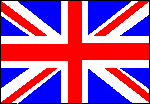
The Sun Never Set on the British Empire, circa 1937
Anonymous Student
Below is a 81.9K animated GIF file. It may take a while to load, though individual frames should display during loading; and then, as the file runs, it may slow down the response of your computer for scrolling and other functions, even when the browser is minimized and other programs are used. The animation can be stopped at any time by hitting the "STOP" key (in Netscape), though I have noticed that this may not work for the Microsoft Internet Explorer. Animation may be restarted by reloading the page or by leaving and returning to the page. Note that Los Angeles, the home of The Proceedings of the Friesian School, is in the same time zone as Vancouver (GMT -8).

Not all British possessions are listed in the image, only representative ones for each of the 24 time zones of the Earth. (All British possessions are listed below.) The time zones themselves may be said to be artifacts of the British Empire, since they are based on the Meridian of Greenwich (at the original Royal Observatory, 1675-1953, in London), which since 1884 is the internationally accepted prime meridian for the calculation of longitude. The animation may also be used to inspect the operation of the International Dateline, which divides the -12h/+12h time zone. It is interesting to note that although several places in the Pacific might fall into the -12h time zone, the Dateline itself and the boundaries of the -11h zone are today drawn in such a way that no jurisdiction uses the -12h zone (Tonga, formerly British, uses +12h; Midway Island & the Aleutians use -11h). Some time zone boundaries have been changed since 1937. Gambia no longer seems to be in the -1h time zone. Also, there have been several time zones that are at a half hour rather than a whole hour interval from Greenwich, including today India (+5h30m), Burma (+6h30m), and central Australia (+9h30m). My source for the 1937 zones (in the Atlas of the British Empire, edited by Christopher Bayly, Facts on File, 1989, p.246) does not clearly indicate these variations, so no attempt is made to represent them.
The "British Empire" was not a de jure entity (like the German Empire, Austrian Empire, Russian Empire, or Japanese Empire), since Britain itself was a kingdom (the "United Kingdom" of Great Britain and Northern Ireland). One British possession, however, was an empire, namely India. Queen Victoria became "Empress of India" in 1876. Subsequently, the term "imperial" worked its way into various official terminology about British possessions, e.g. the "Imperial General Staff" and the "Imperial War Museum." When India and Pakistan became independent in 1947, the Indian Empire ceased to exist and both countries became, for a time, Dominions -- the category for previous British self-governing territories, starting with Canada (1867) and later coming to include the Commonwealth of Australia, New Zealand, the Union of South Africa, and, for a time (1926-1934), little Newfoundland (which did not join Canada until 1949). As the "Empire" faded, the British Commonwealth took over, though that organization seemed to offer less and less as time went on in terms of real economic, military, or political advantages.
Today Queen Elizabeth II is still the official Head of State of scattered former possessions, like the Solomon Islands; but the British connection for the remaining Dominions (Canada, Australia, & New Zealand) has been increasingly compromised and questioned. Canada has come up with its own flag (losing the Union Jack canton), its own national anthem ("Oh Canada!"), its own constitution, and its own perhaps fatal political division between francophone Quebec and all the other, sometimes bitterly resentful (for the cost of bilingualism -- mandated everywhere except Quebec), anglophone provinces. Why Canada should then continue with a "Queen's Government," or even as a single country, is increasingly an open question. When I visited British Columbia as a child in 1959, there were Union Jacks as well as Canadian Ensigns on sale everywhere for tourists. On my last visit to Canada, in 1995, there were no Union Jacks to be seen at all. Meanwhile, Australia, always resentful of much of what happened in World War I (at Gallipoli) and in World War II (at Singapore and in Burma), contains a powerful movement to become a Republic. Recently, however (November 6, 1999), this was put to stand-up vote and lost; so Australia will remain a Dominion for a while yet. The British Empire, in one sense long gone, confirmed with the return of Hong Kong to Communist China in 1997, thus continues a slow fade everywhere. At the same time, British sovereignty in Britain itself becomes increasingly compromised by participation in the ill designed, ill considered, corrupt, and heavy handed Euro-government of the European Community, and by separatist movements in Scotland, Wales, and, as always, Ireland.
In 1909 the British Empire encompassed 20% of the land area of the Earth and 23% of its population. Although the first industrial power, by 1900 Britain had been surpassed by both United States and by Germany; but Britain was still the financial center of the world and the premier merchant carrier.
|
|
1900 | 1914 | |
|---|---|---|---|
| Import/Export millions of £ |
Import/Export millions of £ |
Investment millions of £ | |
| Canada | 22/8 | 22.2/9.6 | 500 |
| United States | 139/20 | 138.8/37.4 | 750 |
| India | 27/30 | 27.4/31.0 | 400 |
| Australia | 24/22 | 23.8/23.6 | 400 |
| New Zealand | 10/6 | 11.6/5.9 | |
| West Indies | 2/4 | 1.8/4.7 | 750 |
| South America | 28/24 | 287.3/216.5 | |
| Europe | 221/118 | 200 | |
| Mediterranean | 27/21 | ||
| Middle East | 19/12 | 1000 | |
| East Asia | 20/26 | ||
| Sub-Saharan Africa |
8/20 | 8.4/21.6 | |
| Bayly's Atlas, pp. 170-171 |
Lloyd's British Empire, p. 423 |
Lloyd's British Empire, p. 258 | |
Indeed, Britain in this period is running a large trade deficit. This is usually taken as a sign of British decline. However, as David Hume noted as early as 1752, this really just means that enough money is exported to make up the difference. This would cause a deflation, unless enough money is created or brought in (for investment) to make up the difference. Since Britain did not experience any deflation after the 1890's, it is fairly clear that the money flows were correcting the balance. This kind of thing was later thought to be indicative of American decline when the United States began to run large trade deficits and in the 1980's became a net debtor from foreign investment in United States securities. However, the dire predictions at the time gave no hint of the relative strength of the United States economy, with good growth, low unemployment, and negligible inflation in the 1990's, with the American advantage over Europe and Japan increasing in the course of the decade. By 1999, the United States economy was all but carrying, Atlas-like, the stagnant or shrinking economies of the rest of the world.
The British balance of trade and balance of payments situation in 1900 thus need not have been an indicator of any real ill health. British decline ultimately had to be from other causes, like an absolute decline in innovation and investment at home. Indeed, when Americans in the 1980's worried about the Japanese buying up the United States, the largest foreign investors were actually British -- which for the future meant American growth rather than British growth.
Another lesson to be read off the trade figures is that a relatively small fraction of British trade involved colonies that would later constitute the "Third World." Indeed, the only trade surpluses in the table are with India, Africa, the West Indies, and the Far East, which might give some heart to Marxist claims that British colonies, especially India, were the outlet for Capitalist "excess production." However, the trade surpluses are small, and overall British trade with India and the other colonies is hardly larger than with the much, much smaller populations of Australia, New Zealand, and Canada. No serious argument can be made that the likes of Australia and New Zealand, with their own autonomous governments and protective tariffs, were being "exploited" by Great Britain. Instead the largest British export market is simply with the rest of Europe. Indeed, Europe, the United States, Australia, Canada, etc. are the places where more people would have enough money to buy British goods.
The figures for investment reveal the truth about the thesis first advanced by J.A. Hobson in 1902 (Imperialism), and later taken up by Lenin, that British conquest followed British investment. Hobson wished to explain the recent Boer War as the effect of £400 million of investment in the South African gold and diamond minds. Lenin saw British colonies as the necessary outlet for British capital, as well as for British capitalist "overproduction." Unfortunately, if this thesis were true, then the British should have been conquering the United States, not South Africa, since the largest single destination of British investment was the Americas, but Canada was the only large scale British possession.
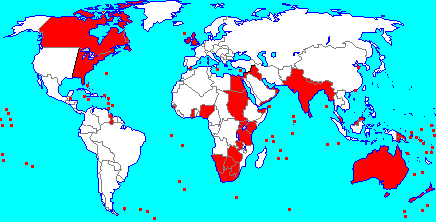 In the following list of present and former British possessions,
current British possessions and dependencies are in boldface red, current
members of the British Commonwealth are in plain red, and independent states in
the Commonwealth that retain Queen Elizabeth as their Head of State are followed
by a crown,
In the following list of present and former British possessions,
current British possessions and dependencies are in boldface red, current
members of the British Commonwealth are in plain red, and independent states in
the Commonwealth that retain Queen Elizabeth as their Head of State are followed
by a crown,  .
The list of Princely States in India is incomplete but is certainly enough to
convey the complexity of the place under British rule.
.
The list of Princely States in India is incomplete but is certainly enough to
convey the complexity of the place under British rule.
The animated GIF file on this page was originally 226.2K in size. Sven Mitsdörffer sent me a 43.8K version, which, however, did not seem entirely compatible with my assembler [the Alchemy Mind Works GIF Construction Set (32-Bit) 1.0Q, 1995]. The present 81.9K image is one that is redone using some of the techniques I found in Sven's version.
British Battleships, "Warrior" 1860 to "Vanguard" 1950, A History of Design, Construction and Armament, by Oscar Parkes, Seeley Service & Co., London, 1957
The Horizon History of the British Empire, edited by Stephen W. Sears, American Heritage Publishing/BBC/Time-Life Books/McGraw-Hill Book Company, 1973
The Pax Britannica Trilogy, by James Morris, Harvest/HBJ/Helen Kurt Wolff Book
The Black Battlefleet, by Admiral G.A. Ballard, Naval Institute Press, 1980
The Oxford Illustrated History of Britain, edited by Kenneth O. Morgan, Oxford, 1984
End of Empire, by Brian Lapping, St. Martin's Press, 1985
Jutland, An analysis of the fighting, by NJM Campbell, Naval Institute Press, 1986
Atlas of the British Empire, edited by Christopher Bayly, Facts on File, 1989
The British Conquest and Dominion of India, Sir Penderel Moon, Duckworth/Indiana University Press, 1989
Dreadnought -- Britain, Germany, and the Coming of the Great War, by Robert K. Massie, Random House, 1991
Great Battles of the Royal Navy, as Commemorated in the Gunroom, Britannia Royal Naval College, Dartmouth, editor-in-chief Eric Grove, Naval Institute Press, 1994
The Royal Navy, An Illustrated History, by Anthony J. Watts, Naval Institute Press, 1994
The British Empire, 1558-1995, by T.O. Lloyd, The Short Oxford History of the Modern World, general editor J.M. Roberts, Oxford, 1996
The Oxford Illustrated History of the Royal Navy, general editor J.R. Hill, Oxford, 1995
The Oxford History of the British Empire
Crucible of War, The Seven Years' War and the Fate of Empire in British North America, 1754-1766, Fred Anderson, Alfred A. Knopf, 2000
Prime Ministers of the Dominions
The Kings of England and Scotland
British Coins before the Florin, Compared to French Coins of the Ancien Régime
| Prime Ministers of Canada | |
|---|---|
| John MacDonald | 1867-1873, 1878-1891 |
| Alexander MacKenzie | 1873-1878 |
| John Abbott | 1891-1892 |
| John Thompson | 1892-1894 |
| Mackenzie Bowell | 1894-1896 |
| Charles Tupper | 1896 |
| Wilfrid Laurier | 1896-1911 |
| Sir Robert Borden | 1911-1920 |
| Arthur Meighen | 1920-1921, 1926 |
| William Lyon MacKenzie King | 1921-1926, 1926-1930, 1935-1948 |
| Richard Bennett | 1930-1935 |
| Louis Saint Laurent | 1948-1957 |
| John Diefenbaker | 1957-1963 |
| Lester Pearson | 1963-1968 |
| Pierre Trudeau | 1968-1979, 1980-1984 |
| Joe Clark | 1979-1980 |
| John Turner | 1984 |
| Brian Mulroney | 1984-1993 |
| Kim Campbell | 1993 |
| Jean Chrétien | 1993-present |
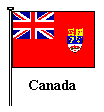 Canada was the first Dominion, a term invented for the specific purpose
of referring to self-governing British possessions, rather than having them be
kingdoms or some other traditional territorial realm.
Canada was the first Dominion, a term invented for the specific purpose
of referring to self-governing British possessions, rather than having them be
kingdoms or some other traditional territorial realm.
Newfoundland did not join Canada until 1949, and for a brief period it was even a Dominion in its own right (1926-1934).
Almost from the beginning Canada had to contend with comparison to, and influence from, the Great Republic to the south. Indeed, one of the first acts of the Dominion was to adopt a Dollar coin equal in value (in gold) to the United States Dollar. Canadian silver and bronze coinage, however, for many years was proportional in size to British coinage. Thus, Canadian silver dollars were smaller than American ones, but nearly equal in size to the British 4 shilling (double florin) coin, which was worth 97 US cents. Until after World War I, Canadian cents were equal in size to the British half-penny, which was worth about one US cent. Briefly, there were Canadian half-cents equal in size to the British farthing.
Expanding an identity for Canada separate from Britain (no one, indeed, ever
would have confused them) became a goal in the 1960's. A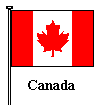 new flag was adopted in 1965, eliminating the Union Jack canton. And a new
National Anthem, "Oh Canada!" is now heard. Since the constitution of Canada was
actually the British North American Act, Pierre Trudeau cut the last legal ties
to Britain by writing a complete, new Constitution. Since that document,
however, makes many special provisions for French-speaking Quebec, it introduced
a source of irritation and binationalism that occasionally threatens to break
Canada apart. One curious result of this was the election of 1993, when the
"Progressive Conservative" Party, despite a woman Prime Minister (Kim Campell),
was all but annihilated, with new power going to regional parties.
new flag was adopted in 1965, eliminating the Union Jack canton. And a new
National Anthem, "Oh Canada!" is now heard. Since the constitution of Canada was
actually the British North American Act, Pierre Trudeau cut the last legal ties
to Britain by writing a complete, new Constitution. Since that document,
however, makes many special provisions for French-speaking Quebec, it introduced
a source of irritation and binationalism that occasionally threatens to break
Canada apart. One curious result of this was the election of 1993, when the
"Progressive Conservative" Party, despite a woman Prime Minister (Kim Campell),
was all but annihilated, with new power going to regional parties.
| Prime Ministers of New Zealand | |
|---|---|
| Richard Seddon | 1893-1906 |
| William Hall-Jones | 1906-1907 |
| Joseph Ward | 1907-1912, 1928-1930 |
| Thomas MacKenzie | 1912 |
| William Massey | 1912-1925 |
| Francis Bell | 1925 |
| Joseph Coates | 1925-1928 |
| George Forbes | 1930-1935 |
| Michael Savage | 1935-1940 |
| Peter Fraser | 1940-1949 |
| Sidney Holland | 1949-1957 |
| Keith Holyoake | 1957, 1960-1972 |
| Walter Nash | 1957-1960 |
| John Marshall | 1972 |
| Norman Kirk | 1972-1974 |
| Hugh Watt | 1974 |
| Wallace Rowling | 1974-1975 |
| Robert Muldoon | 1975-1984 |
| David Lange | 1984-1989 |
| Geoffrey Palmer | 1989-1990 |
| Michael Moore | 1990 |
| Jim Bolger | 1990-1996 |
| Jenny Shipley | 1997-1999 |
| Helen Clark | 1999-present |
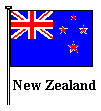 New Zealand contains a large Polynesian population, the Mâori, but otherwise is
alike another Great Britain in the Antipodes. It also boasted the first
officially socialist Government in the world. By the 1990's, however, decades of
socialist attempts to control the economy and "protect" workers had done their
damage. Growth was slow, unemployment high, and "social" spending out of
control. The heroic response was a volte-face that turned New Zealand into one
of the freest economies in the world, with a spurt of growth, investment, and
prosperity. Suddenly, workers could no longer even be forced to join unions as
the result of "collective bargaining." Not all state social entitlement
programs, to be sure, were abolished, but it should be encouraging for all to
see that the creep of social democracy can be dramatically reversed. A recent
setback has been the return to power of the Labourites and the compromise of
some reforms, but one does not expect the Opposition to be out of power forever.
Hopefully, reform will eventually start up again and whole nasty lesson will not
have to be learned all over.
New Zealand contains a large Polynesian population, the Mâori, but otherwise is
alike another Great Britain in the Antipodes. It also boasted the first
officially socialist Government in the world. By the 1990's, however, decades of
socialist attempts to control the economy and "protect" workers had done their
damage. Growth was slow, unemployment high, and "social" spending out of
control. The heroic response was a volte-face that turned New Zealand into one
of the freest economies in the world, with a spurt of growth, investment, and
prosperity. Suddenly, workers could no longer even be forced to join unions as
the result of "collective bargaining." Not all state social entitlement
programs, to be sure, were abolished, but it should be encouraging for all to
see that the creep of social democracy can be dramatically reversed. A recent
setback has been the return to power of the Labourites and the compromise of
some reforms, but one does not expect the Opposition to be out of power forever.
Hopefully, reform will eventually start up again and whole nasty lesson will not
have to be learned all over.
When I lived in Hawai'i in the early 1970's, I was struck by a photo one morning on the front page of the Honolulu Advertiser. A volcano in New Zealand, Mt. Ngauruhoe, was erupting. It was some years before I found an atlas detailed enough to show that particular mountain, one of several active volcanoes on the North Island. At the time, I was interested in Polynesian languages and ended up ordering Bruce Biggs's Let's Learn Maori, book and records, [A.H. & A.W. Reed, Wellington, Auckland, Christchurch, 1969, 1973] through Basil Blackwell at Oxford. It took many months for them to make their way from New Zealand to Oxford and then out to Hawai'i. I rather liked the idea of them around almost entirely around the world to get to me.
After I moved to Texas in 1975, one of my new neighbors, Donna, ordered
something from New Zealand herself, a spinning wheel. It needed to be assembled
and stained, and I helped her out. I even learned from her how to use it. I
thought it was enough fun that I considered buying one myself; but the price,
$50 back then, was far beyond my budget (and the price subsequently went up). I
don't know what I would have done with the thread anyway, since I never got into
weaving the way Donna did. Now, however, the question has arisen again. Donna
bought other spinning wheels, and last year (2000) decided that the original one
was maybe more than she needed. So she offered it to me. It arrived at our house
in January (2001), and I got to put it back together all over again. After 25
some years, I had forgotten how to spin, but Donna had retained, and sent, all
the original documentation, including instructions on use, and the story of how
these particular spinning wheels had been developed in New Zealand, a country
with more sheep than people, during World War II so that women could make
homespun clothing for the boys off in the War. Donna also sent a selection of
materials to spin, including hair from the Angora rabbits that she keeps. As for
what to do with the thread, she says that she even sells some of hers on eBay.
| Prime Ministers of Australia | |
|---|---|
| Edmund Barton | 1900-1903 |
| Alfred Deakin | 1903-1904, 1905-1908, 1909-1910 |
| John Watson | 1904 |
| George Reid | 1904-1905 |
| Andrew Fisher | 1908-1909, 1910-1913, 1914-1915 |
| Joseph Cook | 1913-1914 |
| William Hughes | 1915-1923 |
| Stanley Bruce | 1923-1929 |
| James Scullin | 1929-1932 |
| Joseph Lyons | 1932-1939 |
| Earle Page | 1939 |
| Robert Menzies | 1939-1941, 1949-1966 |
| Arthur Fadden | 1941 |
| John Curtin | 1941-1945 |
| Francis Forde | 1945 |
| Joseph Chifley | 1945-1949 |
| Harold Holt | 1966-1967 |
| John McEwen | 1967-1968 |
| John Gorton | 1968-1971 |
| William McMahon | 1971-1972 |
| Gough Whitlam | 1972-1975 |
| Malcolm Fraser | 1975-1983 |
| Bob Hawke | 1983-1991 |
| Paul Keating | 1991-1996 |
| John Howard | 1996-present |
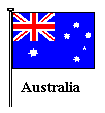 Australia is actually a "Commonwealth" rather than a "Dominion," because
individual Australian states were originally Dominions themselves.
Australia is actually a "Commonwealth" rather than a "Dominion," because
individual Australian states were originally Dominions themselves.
Foreigners know that Australians are called "Aussies." Americans, however (like me), tended to think of the "ss" as pronounced voicelessly, like, indeed, an "s." But it appears that Australians actually pronounce it as a "z": "Auzzie." The Crocodile Dundee movies were largely instrumental in correcting this misperception. The right pronunciation produces several happy puns, like calling Australia itself the "Land of Oz."
Australia may now be the Dominion most tempted by Republicanism. The relationship with Britain has been of a love-hate variety ever since the first shipload of prisoners arrived at Botany Bay. Real strain began in World War I. Britain declared War against Germany in the name of all the Dominions without actually asking them, or even telling them, first. This was an irritation that could be perhaps forgiven, once. Australians enthusiastically volunteered for the Army, and the ANZAC, "Australia-New Zealand Army Corps," entered combat. Unfortunately, the combat ended up being at Gallipoli, where Winston Churchill had gotten the idea of seizing the Dardanelles and putting Turkey out of the War. This was a good idea, but amphibious landings were a new idea, and the campaign ended up poorly conducted, and a failure. There was great slaughter on both sides, but many of the Allied dead were specifically Australians and New Zealanders. Were the British really this careless? Or were they just careless with the ANZAC's? Well, that was World War I, but the Australians can certainly be forgiven for some resentment about dying in a campaign that owned nothing to their direction or consent.
The postwar era got off to a bad start with the Washington Naval Treaty (1921), whereby Britain accepted naval parity with the United States and agree with Japan to limit its military presence in the Pacific. This gravely compromised Britain's defense responsibilities to Australia and New Zealand; and, again, it looked like Britain was making its own decisions without concern or consultation about the Pacific Dominions. Meanwhile, in the 20's and 30's, the Dominions were recognized as independent in all but name. In the Statute of Westminster of 1931, the British Parliament renounced all legislative, even constiutional, authority over the Dominions. This could not mean that they were simply on their own, however. Australia and New Zealand did not have the means to defend themselves against Japan and had no desire to do so alone.
When Japan entered World War II, Britain was already stretched thin. And the ANZAC force was in North Africa. The whole British position in the Pacific depended on the base at Singapore, with obsolete aircraft and few ships. The Japanese landed in Malaya, drove against Singapore and, in part by bluff against a larger force, compelled a British surrender. Many Australians ended up dying in Japanese prison camps, or suffering to build the infamous Japanese railroad from Thailand to Burma (as seen in The Bridge on the River Kwai [1957]). Britain had little left to offer for the defense of the South Pacific. Only America could help, and the war effort in New Guinea and the Solomons came to be a cooperative ANZAC-American effort. Henceforth, while Constitutional ties were retained with Britain, Australia would always be as much a partner of the United States as of the "Mother" country. Republican advocates, like the art critic and historian Robert Hughes, seem to spend as much time in the United States as Down Under. And the British ("bloody pommies") would never understand surfing.
| Prime Ministers of South Africa | |||
|---|---|---|---|
| Louis Botha | 1910-1919 | ||
| Jan Christiaan Smuts | 1919-1924, 1939-1948 | ||
| James Hertzog | 1924-1939 | ||
| Daniel Malan | 1949-1954 | ||
| Johannes Strijdom | 1954-1958 | ||
| Hendrik Verwoerd | 1958-1966 | ||
| South Africa becomes a Republic, leaves Commonwealth, 1961 | |||
| Presidents | |||
| Charles Robberts Swart |
1961-1967 | ||
| Jozua François Naudé |
acting, 1967-1968 |
B. J. Vorster |
1966-1978 |
| Jacobus Johannes Fouchá |
1968-1975 | ||
| Nicolaas J. Diederichs |
1975-1978 | ||
| Marais Viljoen | acting, 1978 |
1978-1984 | Pieter Willem Botha |
| B. J. Vorster | 1978-1979 | ||
| Marais Viljoen | 1979-1984 | ||
|
| |||
| J. Christian Heunis | acting, 1989 | ||
| Frederik W. de Klerk | 1989-1994 | ||
| Nelson Mandela | 1994-1999 | ||
| Thabo Mbeki | 1999- | ||
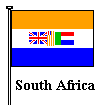 The Union of South Africa was formed from the British colonies of the Natal and
the Cape Colony, together with the subjugated Boer Republics of the Transvaal
and the Orange Free State. The flag of the Union was, significantly, an
archaizing Dutch
flag, with an orange instead of a red stripe, and the flag of Britain, the
Orange Free State, and the Transvaal on the middle stripe. Since the Boers never
wanted to be ruled by Britain in the first place, and they had gone on the Great
Trek into the interior to get away from them, it was perhaps only a matter of
time before this was made good. Meanwhile, relations were cordial enough, and
General Smuts became a familiar elder statesman of the British Empire, though in
World War II South Africans refused to fight anyplace but in Africa -- little
did they know that very serious fighting would actually occur in North Africa
(though General Smuts himself had encountered tough fighting in World War I
against the Germans
in Tanganyika). In 1948, however, Boer nationalism seized the helm. The laws
that had always been discriminatory and humiliating against non-whites, against
which Mahâtma Gandhi had
already been fighting in the 1890's, were then expanded into the rigid,
police-state-like system of Apartheid. By 1960, with African colonies
becoming independent, and the harsh racist principles and rhetoric of the Boers
all too reminiscent of Hitler, this had grown into an embarrassment, and worse.
The Union of South Africa was formed from the British colonies of the Natal and
the Cape Colony, together with the subjugated Boer Republics of the Transvaal
and the Orange Free State. The flag of the Union was, significantly, an
archaizing Dutch
flag, with an orange instead of a red stripe, and the flag of Britain, the
Orange Free State, and the Transvaal on the middle stripe. Since the Boers never
wanted to be ruled by Britain in the first place, and they had gone on the Great
Trek into the interior to get away from them, it was perhaps only a matter of
time before this was made good. Meanwhile, relations were cordial enough, and
General Smuts became a familiar elder statesman of the British Empire, though in
World War II South Africans refused to fight anyplace but in Africa -- little
did they know that very serious fighting would actually occur in North Africa
(though General Smuts himself had encountered tough fighting in World War I
against the Germans
in Tanganyika). In 1948, however, Boer nationalism seized the helm. The laws
that had always been discriminatory and humiliating against non-whites, against
which Mahâtma Gandhi had
already been fighting in the 1890's, were then expanded into the rigid,
police-state-like system of Apartheid. By 1960, with African colonies
becoming independent, and the harsh racist principles and rhetoric of the Boers
all too reminiscent of Hitler, this had grown into an embarrassment, and worse.
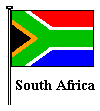 In 1961, after condemnation at a Commonwealth Conference, the Union
was turned into a Republic, which left the Commonwealth, to live under
international hostility through the 60's, 70's, and 80's, until a peaceful
transition to majority rule in 1994. Whether the new South Africa will be able
to remain peaceful is a good question. Already with a very high crime
rate, the precedent of neighboring Zimbabwe, with one party rule and the
increasing expropriation of white farms, usually by informal violence, is not
reassuring.
In 1961, after condemnation at a Commonwealth Conference, the Union
was turned into a Republic, which left the Commonwealth, to live under
international hostility through the 60's, 70's, and 80's, until a peaceful
transition to majority rule in 1994. Whether the new South Africa will be able
to remain peaceful is a good question. Already with a very high crime
rate, the precedent of neighboring Zimbabwe, with one party rule and the
increasing expropriation of white farms, usually by informal violence, is not
reassuring. | Prime Ministers of Ireland | |||
|---|---|---|---|
| Eamon De Valera | 1919-1922 | ||
| Arthur Griffith | 1922 | ||
| Michael Collins | 1922 | ||
| William Cosgrave | 1922-1932 | ||
| Eamon De Valera | 1932-1948, 1951-1954, 1957-1959 | ||
| Ireland becomes a Republic, 1938; leaves Commonwealth, 1949 | |||
| Presidents | |||
| Douglas Hyde | 1938-1945 | ||
| Sean O'Kelly | 1945-1959 | John Costello | 1948-1951, 1954-1957 |
| Eamon De Valera | 1959-1973 | Sean Lemass | 1959-1966 |
| Jack Lynch | 1966-1973, 1977-1979 | ||
| Erskine Childers | 1973-1974 | ||
| Carroll Daly | 1974-1976 | Liam Cosgrave | 1973-1977 |
| Patrick Hillery | 1976-1990 | Charles Haughey |
1979-1981, 1982, 1987-1992 |
| Garret FitzGerald |
1981-1982, 1982-1987 | ||
| Mary Robinson | 1990-1997 | Albert Reynolds |
1992-1994 |
| John Bruton | 1994-1997 | ||
| Mary McAleese | 1997- | Bertie Ahern | 1997- |
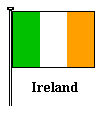 Ireland gained independence as a Dominion -- though I have also seen this
denied. The original idea was Home Rule, which would have made it an autonomous
Kingdom within the United Kingdom of Great Britain and Ireland. Several Liberal
British governments fell over Home Rule bills. When one finally passed, World
War I led the British to delay its effect. Then in 1916 there was an Irish
Rising. None of this made anyone any happier. When autonomy finally came in
1921, however, the terms were the subject of bitter debate in Ireland. Britain
expected there to be a Governor-General and a loyalty oath to the King.
Acceptance of these terms led to near Civil War in Ireland. Michael Collins was
killed by the Irish Republican Army, and Eamon De Valera was imprisoned by the
Irish government. When De Valera came to power in 1932, the loyalty oath was
abolished, the Governor-General was stripped of all power, and then in 1938 a
Republic was declared, just in time for World War II (and Irish neutrality --
though many Irish fought in the British Army nevertheless). The expectation of
many British colonial possessions, that they would suddenly become rich once the
predatory British were gone, was repeated in Ireland. And consequently Ireland
remained for many years one of the poorest countries in Europe. By 1986
unemployment was over 15%, inflation at 10%, growth only 0.4%, and the budget
bleeding hopelessly. As in the days of the potato famine, people left Ireland
for better lives elsewhere. The English, and even the Irish, told "stupid Irish"
jokes. Then Ireland awoke. The supply-side, Reagan/Thatcher
formula of tax cuts was adopted, and the economy took off like a rocket. Ireland
is now growing at triple the rate of the European Union, 9.4% per year. People
now move into Ireland, not out of it. There is a budget surplus. American
companies put their European headquarters there. Unemployment, at 15.7% in 1993,
was down to under 5% in 2000. Public housing, which an audit discovered cost
more to run than if it were just built and given away to tenants, is being sold
off. Brussels, the statist headquarters of the European Union, which continues
to love high taxes, is screaming; but Irish finance minster, Charlie McCreevy,
is telling them where to get off. What a blessed day for what was so long a sad
and suffering land. How wonderful what a little real capitalism will do. Erin
go brah! As in the days of St. Columba, they now could use a little of the
Irish formula in Great Britain, which has forgotten its Thatcherite wisdom.
Never have I been happier to be a Kelley.
Ireland gained independence as a Dominion -- though I have also seen this
denied. The original idea was Home Rule, which would have made it an autonomous
Kingdom within the United Kingdom of Great Britain and Ireland. Several Liberal
British governments fell over Home Rule bills. When one finally passed, World
War I led the British to delay its effect. Then in 1916 there was an Irish
Rising. None of this made anyone any happier. When autonomy finally came in
1921, however, the terms were the subject of bitter debate in Ireland. Britain
expected there to be a Governor-General and a loyalty oath to the King.
Acceptance of these terms led to near Civil War in Ireland. Michael Collins was
killed by the Irish Republican Army, and Eamon De Valera was imprisoned by the
Irish government. When De Valera came to power in 1932, the loyalty oath was
abolished, the Governor-General was stripped of all power, and then in 1938 a
Republic was declared, just in time for World War II (and Irish neutrality --
though many Irish fought in the British Army nevertheless). The expectation of
many British colonial possessions, that they would suddenly become rich once the
predatory British were gone, was repeated in Ireland. And consequently Ireland
remained for many years one of the poorest countries in Europe. By 1986
unemployment was over 15%, inflation at 10%, growth only 0.4%, and the budget
bleeding hopelessly. As in the days of the potato famine, people left Ireland
for better lives elsewhere. The English, and even the Irish, told "stupid Irish"
jokes. Then Ireland awoke. The supply-side, Reagan/Thatcher
formula of tax cuts was adopted, and the economy took off like a rocket. Ireland
is now growing at triple the rate of the European Union, 9.4% per year. People
now move into Ireland, not out of it. There is a budget surplus. American
companies put their European headquarters there. Unemployment, at 15.7% in 1993,
was down to under 5% in 2000. Public housing, which an audit discovered cost
more to run than if it were just built and given away to tenants, is being sold
off. Brussels, the statist headquarters of the European Union, which continues
to love high taxes, is screaming; but Irish finance minster, Charlie McCreevy,
is telling them where to get off. What a blessed day for what was so long a sad
and suffering land. How wonderful what a little real capitalism will do. Erin
go brah! As in the days of St. Columba, they now could use a little of the
Irish formula in Great Britain, which has forgotten its Thatcherite wisdom.
Never have I been happier to be a Kelley. | Prime Ministers of India | |||
|---|---|---|---|
| Jawaharlal Nehru | 1947-1964 | ||
| India becomes a Republic, 1950 | |||
| Presidents | |||
| Rajendra Prasad | 1950-1962 | ||
| Sarvapalli Radhakrishnan |
1962-1967 | Lal Bahadur Shastri |
1964-1966 |
| Zakir Husain | 1967-1969 | Indira Gandhi | 1966-1977, 1980-1984 |
| Varahagiri Venkata Giri |
acting, 1969 | ||
| Muhammad Hidayat Ullah |
acting, 1969 | ||
| Varahagiri Venkata Giri |
1969-1974 | ||
| Fakhruddin Ali Ahmed |
1974-1977 | ||
| Basappa Danappa Jatti |
acting, 1977 | Morarji Desai | 1977-1979 |
| N. Sanjiva Reddy | 1977-1982 | Charan Singh | 1979-1980 |
| Zail Singh | 1982-1987 | Rajiv Gandhi | 1984-1989 |
| Ramaswamy Venkataraman |
1987-1992 | Vishwanath Pratap Singh |
1989-1990 |
| Chandra Shekhar | 1990-1991 | ||
| Shankar Dayal Sharma |
1992-1997 | P.V. Narasimha Rao |
1991-1996 |
| H.D. Deve Gowda |
1996-1997 | ||
| Kircheril Raman Narayanan |
1997- | Inder Kumar Gujral |
1997-1998 |
| Atal Bihari Vajpayee |
1998- | ||
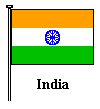 India
and Pakistan both became independent as Dominions, mainly because the procedures
for doing this already existed and it could be done quickly. India then soon
enough became a Republic. Bitterness, however, was minimal, and India remained a
friendly member of the British Commonwealth. Although Mahâtmâ Gandhi was affectionately,
reverently regarded as the father of Indian independence, he never had the
slightest interest in exercising political power, and Nehru, a British educated
Brahmin, had always been the logical choice. Unfortunately, Nehru had been
educated in the fashionable socialism of the day and immediately applied to
India the tried and true techniques of that paradigm of economic development,
the Soviet Union. This, of course, condemned India to decades of continued
poverty, even while Indian emigrants prospered mightily elsewhere. The day of
reckoning may have come in 1991, when the new Prime Minister, P.V. Narasimha
Rao, discovered that the country's gold reserves had been flown to London to
cover an International Monetary Fund loan, itself sought because of the looming
exhaustion of foreign reserves. Soon Rao's government was moving to liberalize
the economy, allowing foreign investment and something approaching free,
certainly freer, trade. Most importantly, the "License Raj," by which no
business count start, or do much else, without the endless red tape of
government permission, was in great measure dismantled. The economic acumen of
Indians now could be manifest in India itself, not just in emigrant communities.
The effects of the Nehruist folly have not been shaken off completely, however.
The government itself is still a vast parasite on the economy, it is all but
impossible to fire workers, and bankrupt or unproductive businesses cannot
legally close or lay off workers. The State of Bengal remains in the grip of an
actual Communist
government, with monuments to Ho Chi Minh and the other luminaries of leftist
murder and dictatorship. Since Bengal, like adjacent Bangladesh itself, remains
about the poorest place on Earth, one wonders when such people will give
themselves a break.
India
and Pakistan both became independent as Dominions, mainly because the procedures
for doing this already existed and it could be done quickly. India then soon
enough became a Republic. Bitterness, however, was minimal, and India remained a
friendly member of the British Commonwealth. Although Mahâtmâ Gandhi was affectionately,
reverently regarded as the father of Indian independence, he never had the
slightest interest in exercising political power, and Nehru, a British educated
Brahmin, had always been the logical choice. Unfortunately, Nehru had been
educated in the fashionable socialism of the day and immediately applied to
India the tried and true techniques of that paradigm of economic development,
the Soviet Union. This, of course, condemned India to decades of continued
poverty, even while Indian emigrants prospered mightily elsewhere. The day of
reckoning may have come in 1991, when the new Prime Minister, P.V. Narasimha
Rao, discovered that the country's gold reserves had been flown to London to
cover an International Monetary Fund loan, itself sought because of the looming
exhaustion of foreign reserves. Soon Rao's government was moving to liberalize
the economy, allowing foreign investment and something approaching free,
certainly freer, trade. Most importantly, the "License Raj," by which no
business count start, or do much else, without the endless red tape of
government permission, was in great measure dismantled. The economic acumen of
Indians now could be manifest in India itself, not just in emigrant communities.
The effects of the Nehruist folly have not been shaken off completely, however.
The government itself is still a vast parasite on the economy, it is all but
impossible to fire workers, and bankrupt or unproductive businesses cannot
legally close or lay off workers. The State of Bengal remains in the grip of an
actual Communist
government, with monuments to Ho Chi Minh and the other luminaries of leftist
murder and dictatorship. Since Bengal, like adjacent Bangladesh itself, remains
about the poorest place on Earth, one wonders when such people will give
themselves a break.
Looming large in recent Indian history is not just Jawaharlal Nehru but his
family. Nehru's daughter Indira dominated the country for nearly twenty years.
When she arrested the opposition, India briefly lost its democracy. When she
figured on a vote of confidence from the people in 1977, she was voted out of
power instead. The opposition, however, was no more popular; and Indira returned
to office in 1980. Ordering a military suppression of the Sikhs, she was assassinated
by a Sikh guard in 1984. Her son Rajiv was also assassinated.
| Prime Ministers of Pakistan | |||
|---|---|---|---|
| Liaquat Ali Khan | 1947-1951 | ||
| Khawaja Nazimuddin | 1951-1953 | ||
| Muhammad Ali Bogra | 1953-1955 | ||
| Chawdry (Chaudhri) Muhammad Ali |
1955-1956 | ||
| Hussein Shahid Suhrawardi | 1956-1957 | ||
| Pakistan becomes a Republic, 1956; out of Commonwealth, 1972-1989 | |||
| Presidents | |||
| Iskander Mirza | 1956-1958 | Ismail Chundrigar |
1957 |
| Malik Feroz Khan Noon |
1957-1958 | ||
| 1958-1969 | Muhammad Ayub Khan |
1958 | |
| Agha Muhammmad Yahya Khan |
1969-1971 | ||
| 1971-1973 | Zulfikar Ali Bhutto | ||
| Fazal Elahi Chawdry |
1973-1978 | 1973-1977 | |
| Muhammad Zia-ul-Haq |
1978-1988 | ||
| Muhammad Khan Junejo |
1985-1988 | ||
| Ghulam Ishaq Khan |
1988-1993 | Muhammad Aslam Khan Khattak |
1988 |
| Benazir Bhutto | 1988-1990, 1993-1996 | ||
| Mustafa Jatoi | 1990 | ||
| Nawaz Sharif | 1990-1993, 1996-1999 | ||
| Farouk Ahmed Leghari |
1993-1997 | ||
| Muhammad Rafiq Tarar |
1997- | Pervez Musharraf |
1999- |
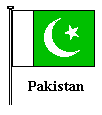 With a slightly greater delay, Pakistan followed India to become a Republic.
Pakistan left the Commonwealth for a while after India, and international
opinion, supported the revolt of East Pakistan against the Western dominated
central Government. The East then became Bangladesh, the "Bengal Nation," which
retained its own Commonwealth membership. Unlike India, Pakistan has had long
periods of military rule, but has distinguished itself as the only Islâmic
country to have been led by a woman, the admirable Benazir Bhutto.
With a slightly greater delay, Pakistan followed India to become a Republic.
Pakistan left the Commonwealth for a while after India, and international
opinion, supported the revolt of East Pakistan against the Western dominated
central Government. The East then became Bangladesh, the "Bengal Nation," which
retained its own Commonwealth membership. Unlike India, Pakistan has had long
periods of military rule, but has distinguished itself as the only Islâmic
country to have been led by a woman, the admirable Benazir Bhutto.
Some periods of outright dictatorship, under Ayub Khan, Yahya Khan, and Zia-ul-Haq, are evident from the absence of a Prime Minister. The secession of East Pakistan and the disastrous defeat by India over it led to the tenure of Zulfikar Ali Bhutto, who was later executed, supposedly for corruption under his rule. Benazir was his daughter and set out to vindicate him.
The red, white, and blue of the flags of Britain, Canada, Australia, and New
Zealand contrast with the oranges and greens that turn up in the flags of South
Africa, Ireland, India, and Pakistan. The orange of South Africa and Ireland is
actually of the same origin, the Dutch House of Orange, following the Dutch
settlers of South Africa and the cause of the Protestants of Ireland, delivered
from James II by William of Orange. The Republican tricolor of Ireland hopefully
lays the white of peace between Protestant orange and Irish green. The green of
India and Pakistan is also of the same origin, for Islâm, which India hopes to
reconcile with Hinduism as Ireland hopes for the Protestants and Catholics.
Pakistan, however, was founded to be a purely Islâmic state.
The Kings of England and Scotland
British Coins before the Florin, Compared to French Coins of the Ancien Régime